LIGHT SPORT PILOT TRAINING FAQS (2026)
Straight answers for beginners near Kansas City and St. Joseph on where you train, how lessons work, what it costs, what to bring on day one, and where the certificate can take you.
FAQ / LIGHT SPORT PILOT TRAINING
Light Sport Pilot Training Questions
If you are looking for light sport pilot training near you, these are the questions beginners in Kansas City, St. Joseph, and Northwest Missouri ask us most. For the full program, see our sport pilot program, and follow the links below when you want more detail on one topic.
A discovery flight is the easiest way to see the airport, meet an instructor, and find out if sport pilot training fits your life before you enroll.
- 01
Where do your light sport pilot lessons take place?
- Every lesson starts and ends at Rosecrans Memorial Airport (KSTJ) in St. Joseph, MO, which is close to home if you live in St. Joseph or elsewhere in Northwest Missouri. Traffic at KSTJ is light, so more of each hour you pay for is spent flying instead of waiting for a turn to take off. Our sport pilot program page shows what the training covers.
- 02
I live in the Kansas City area. How do I make the drive work?
- KSTJ is about 45 to 60 minutes from Kansas City, and many of our students make that drive. The easiest way to make each trip count is to book back-to-back lessons on the same day, for example a flight and a ground or simulator session. You book online and can see which instructors and airplanes are open before you get in the car. Read more about pilot training for Kansas City students.
- 03
Is there housing for students coming from farther away?
- Yes. We have limited on-airfield housing with private, furnished rooms that include a bed, a study desk, and high-speed internet, a short walk from the airplanes. We can also help you find accommodations off the airport. Rooms are limited, so see our student housing and contact us early to check what is open for your dates.
- 04
How often should I fly during sport pilot training?
- Most of our part-time students fly two or three lessons a month and finish in about six months. That is our typical pace, and your schedule, the weather, and how much you study between lessons all move it. You can train weekly, every other week, or monthly. Long gaps mean the start of each lesson goes to review, so a steady rhythm usually costs less. Our guide to sport pilot lessons week by week shows how those months usually lay out.
- 05
What happens during a typical sport pilot lesson?
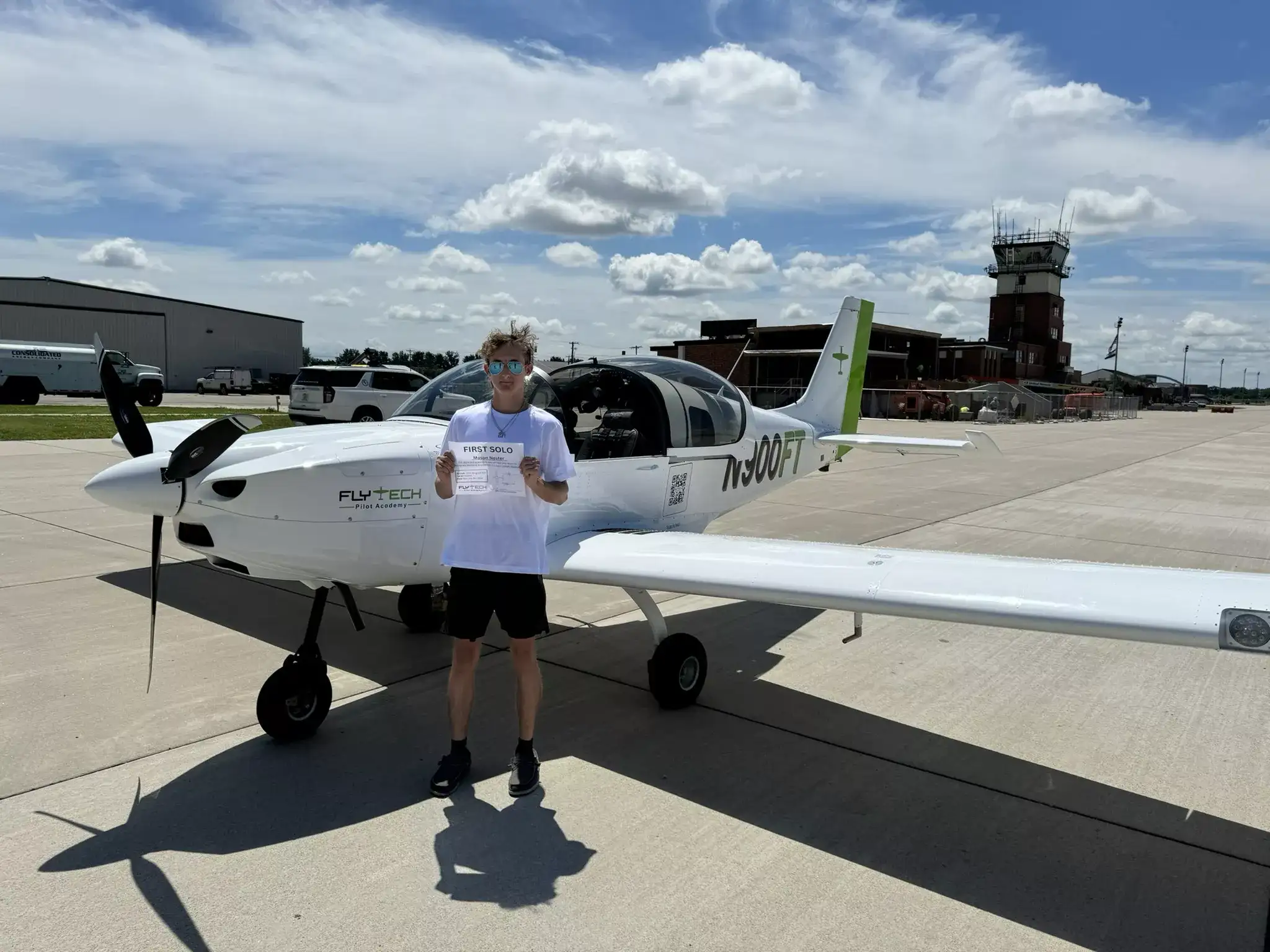
- Each lesson has three parts: a ground briefing, the flight, and a debrief. Your instructor explains what you will practice, you fly it in our Sling LSA, and afterward you talk through what went well and what to work on next. Your instructor then signs a logbook entry that describes the training and how long it lasted. Early lessons cover the basics of controlling the airplane, then landings, your first solo, and cross-country flying. If you want to picture day one, read your first sport pilot lesson.
- 06
What happens if weather cancels my lesson?
- Weather cancellations are rescheduled at no charge. If you would rather keep the time slot, we can turn it into a ground session or practice in our Redbird MCX full-motion simulator, and that session is billed at its own rate. For cancellations that are not weather related, we ask for at least 24 hours' notice to avoid charges.
- 07
How much does a sport pilot certificate cost at FlyTech?
- Our estimate for the full Sport Pilot Certificate is around $8,500, paid as you go, lesson by lesson. Your actual total depends on how many lessons you need. There is no large payment up front, and you can also buy bulk time at a discounted rate. Financing options include Stratus Financial, AOPA financing for recreational flyers, and loans from local banks. Our financing page explains how to apply.
- 08
How are individual lessons billed?
- You pay for the time you use at our posted rates: $185 an hour for the airplane (wet, so fuel is included), $60 an hour for your instructor in the air or at the briefing table, $50 an hour for the simulator plus your instructor's time, and $30 an hour for group ground school. On a solo flight you pay for the airplane only. Each flight shows up as its own invoice in our online scheduling system. For worked examples, read how much a sport pilot lesson costs, and contact us to confirm current rates.
- 09
What do I need to bring to get started?
- Most students start with a discovery flight and then enroll. At enrollment, bring a U.S. passport, or your driver's license or state ID with your birth certificate, because federal security rules (TSA) require flight schools to verify U.S. citizenship before flight training begins. If you are not a U.S. citizen, contact us before you book, since TSA has a separate approval process. You will also apply for a student pilot certificate through the FAA's IACRA system, and your instructor reviews and signs the application. You can fly lessons before it arrives, but you need it before your first solo, so apply early.
- 10
How old do I have to be for sport pilot training?
- You must be at least 16 to fly solo with a student pilot certificate and at least 17 to earn the Sport Pilot Certificate. If you are under 18, a parent or guardian signs the liability waiver at enrollment.
- 11
Do I need an FAA medical, or is my driver's license enough?
- For sport pilot training, a valid U.S. driver's license can take the place of an FAA medical, including when you fly solo and after you earn the certificate. The conditions are that you follow any restrictions on your license, your most recent FAA medical application (if you ever made one) was not denied, your most recent medical was not suspended or revoked, and you know of no medical condition that would make flying unsafe. If any of that is unclear for you, talk with us before you enroll.
- 12
How many hours does the Sport Pilot Certificate take?
- The FAA minimum is 20 hours: at least 15 with your instructor and at least 5 solo. Those hours include 2 hours of cross-country training with your instructor, 10 takeoffs and landings to a full stop, one solo cross-country of at least 75 nautical miles with full-stop landings at two or more airports and one leg of at least 25 nautical miles, and at least 2 hours of checkride prep with your instructor in the two calendar months before your test month. You also pass the FAA knowledge test and a checkride with an examiner. Twenty hours is a minimum, many students need more, and your instructor decides when you are ready.
- 13
What does a Sport Pilot Certificate let me do?
- You can fly for fun with one passenger, in the daytime, with at least 3 miles of visibility. You cannot fly for hire, and night flying needs extra training and an instructor endorsement. Since October 22, 2025, the FAA's MOSAIC rules let sport pilots fly airplanes with a clean stall speed of 59 knots or less and up to four seats, still with one passenger. Whether a given airplane qualifies depends on its certificated data. Our sport students train in the Sling LSA, a two-seat glass-cockpit airplane. Read more in Sport Pilot in the MOSAIC Era.
- 14
Can I move on to a private pilot certificate later?
- Yes. Your sport hours stay in your logbook and count toward a private certificate. A private certificate needs at least 40 hours plus training a sport certificate does not include, such as night flying, flying by reference to instruments, a longer solo cross-country of at least 150 nautical miles, and solo landings at a towered airport. Private pilots also need an FAA medical certificate, or BasicMed if you qualify. You can keep training in the same Sling. See our private pilot program, and if you are still comparing schools, read 7 questions to ask before you enroll.
If you have any additional questions please send us an email to Book a Discovery Flight
Still Have Questions?
Experience It Firsthand
Book a Flight and get a firsthand feel for flying with FlyTech. It’s the perfect way to decide if aviation is right for you, and we’ll be happy to answer your questions in person.